
Type 2 Diabetes Rarely Stays Simple. Here's Why That Means So Many Doctors.
Type 2 diabetes isn't just a blood sugar number — it affects your heart, kidneys, eyes, nerves, and feet. That's why it tends to involve more doctors than people expect, and why so much falls through the cracks between them.

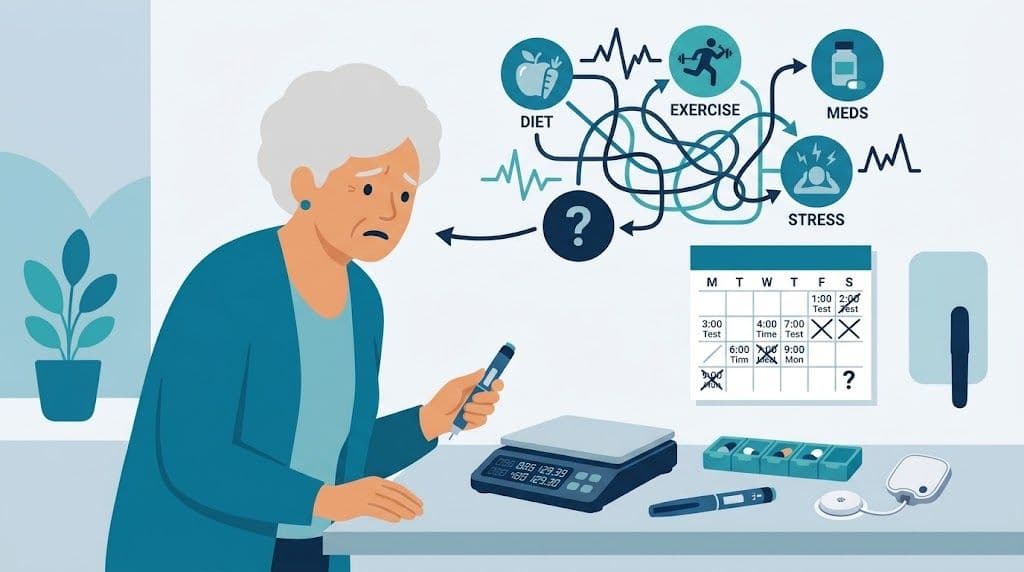
Type 2 Diabetes Means a Lot of Doctors. Here's Why — and How to Keep It Together.
Type 2 diabetes gets talked about as a blood sugar problem. In practice, it's a whole-body condition, touching the heart, kidneys, eyes, nerves, and feet — often years before most people realize it.¹ That's why diabetes care tends to expand well past a single doctor over time, and why keeping it all straight is harder than it should be.
It's Not Just Blood Sugar
The numbers explain a lot. About 2 in 3 people with diabetes have high blood pressure or are already being treated for it.² Cardiovascular disease shows up in roughly 1 in 3 people with type 2 diabetes globally.³ Diabetes-related eye damage affects fewer than 1 in 20 patients at diagnosis but climbs past 40% within ten years — and by that same point, about a quarter of patients are managing five or more coexisting conditions, not just one.⁴
That's not meant to alarm anyone. It's meant to explain something rarely said out loud: type 2 diabetes rarely stays simple, and the systems it touches genuinely need different kinds of expertise.
Which Is Why It Involves So Many Doctors
Primary care for the whole picture, an endocrinologist for glucose, a cardiologist if the heart's involved, an ophthalmologist for annual eye exams, a podiatrist for foot health, often a dietitian too. Research on how patients feel about this found something reassuring — most people with type 2 diabetes aren't bothered by having a team.⁵ What they consistently want is one point of contact who can make it all add up to a single picture instead of five separate ones.
What Tends to Get Lost
Without that single point of contact, a few things happen almost every time care is this spread out: a medication change from one doctor doesn't reach the others, something flagged at one visit never comes up again, and "so what have your other doctors said?" gets answered from memory at nearly every appointment. None of that is one doctor's fault. It's what happens when complex care is split across people who don't share a chart.
What Tends to Help
People who manage this well across multiple providers tend to do a few things: keep a current medication list on hand rather than relying on memory, ask directly whether something should be flagged for the rest of their care team, and keep everything they've been told to "watch for" in one place instead of scattered across visits. Some people use a notebook. Some use their phone. Some use Clareo, which — with a clinician's permission — turns each appointment into a summary you can carry into the next one, regardless of which doctor or health system it's with.
Whatever the method, the pattern is the same: type 2 diabetes is more complex than it gets credit for, and it holds together a lot better when the information does too.
References
- Prevalence of cardiovascular disease in type 2 diabetes: a systematic literature review, 2007–2017. Cardiovasc Diabetol. 2018.
- American Diabetes Association, cited in: What are some comorbidities of type 2 diabetes? Medical News Today.
- Prevalence of cardiovascular disease in type 2 diabetes: a systematic literature review, 2007–2017. Cardiovasc Diabetol. 2018.
- Variations in comorbidity burden in people with type 2 diabetes over disease duration. eClinicalMedicine. 2022.
- Multidisciplinary coordinated care for Type 2 diabetes: A qualitative analysis of patient perspectives. Prim Care Diabetes. 2018.